
If you’re looking for an in-depth discussion on the disabilities covered under the NDIS, then, indeed, you’ve come up to the right blog. This will help you understand the topic through the lens of an expert. So, let’s uncover “what disabilities are covered under the NDIS?”.
Table of Contents
What Disabilities Are Covered Under The NDIS? Quick Facts
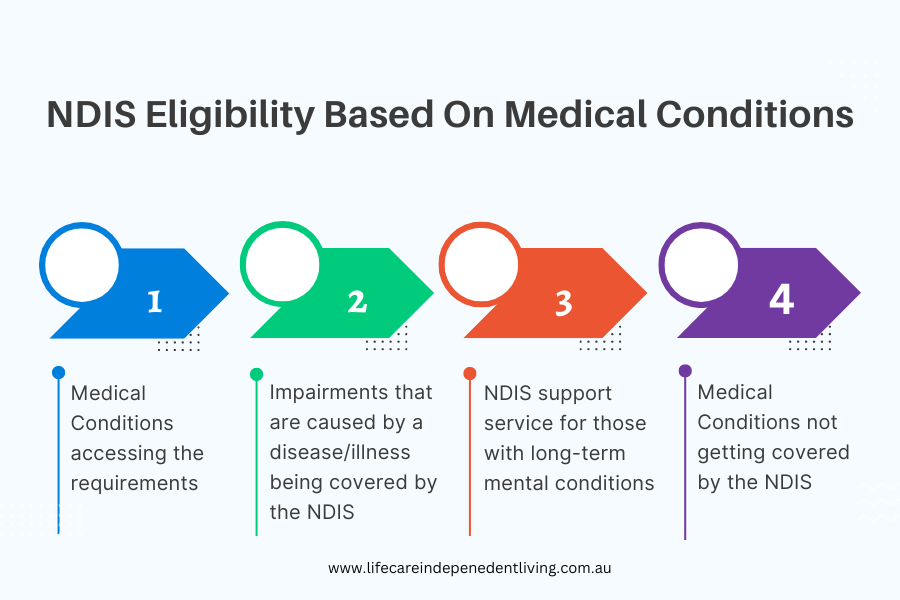
NDIS Eligibility Based On Medical Conditions
In case you’re confused regarding the medical conditions that will put you under the eligibility criteria guided by NDIS. This section will resolve all your doubts.
Medical Conditions accessing the requirements
So, firstly, the individuals who are diagnosed with List A medical conditions are primarily aligned with the disability requirements. This is because of the variant conditions that tend to lead to permanent disability and impairment. This has resulted in a considerable reduction of functional capacity.
On the other hand, people who are diagnosed with List B medical conditions are mainly undergoing permanent impairment. Nonetheless, the degree of impairment differs. This will be required to showcase the impairment results.
Impairments that are caused by a disease/illness being covered by the NDIS
An individual with some sort of permanent impairment like physical, visual, neurological, intellectual, hearing, and psychosocial. For example, some of the following disability –
- Strokers causing hemiparesis
- Severe emphysema leads to non-changeable lung damage.
NDIS support service for those with long-term mental conditions
People with a significant disability that is the most prominent permanent aspect can qualify for NDIS
support.
Medical Conditions not getting covered by the NDIS
- Non-ongoing or time-limited conditions, such as decreased movement due to an acute injury, are not likely to align with the requirements of NDIS disability.
- NDIS does not support or give funds for chronic health conditions that are not concerned with the disability of a person.
- The NDIS refrains from funding medical care or fund medications, which does not check the list of all the access requirements.
After discussing these details, it’s time to clarify the different conditions of each List that are covered under the NDIS.
What Disabilities Are Covered Under The NDIS? List A Conditions
List A Conditions are the ones that are most likely to meet the disability requirements. These scenarios have been interlinked with permanent impairment along with substantially decreased functional potentialities. People with these kinds of disabilities do not need any further assessment.
- Diagnosis and Assessment of intellectual disability as profound, severe, or moderate based on the existing DSM criteria.
- The specialist team diagnoses, using the criteria of DSM-V, the person having Autism Spectrum Disorder. This needs substantial (Level 2) and very substantial support (Level 3).
- Diagnosis and assessment of Cerebral palsy based on severity.
- Some of the severe and permanent physical and intellectual impairments caused due to genetic conditions:
- Angelman Syndrome
- Edwards syndrome
- Cri du chat syndrome
- Epidermolysis Bullosa in the extreme forms of YR, Hallopeau-Siemen type, and others.
- Leigh syndrome
- Leukodystrophies include Canavan disease, Krabbe disease, Alexander disease, etc.
- Lysosomal storage disorders that result in severe physical and intellectual impairments, such as Niemann Pick disease, Pompe disease, Schindler disease, and others.
- Mucopolysaccharidoses in the following forms like MPS 1-H, MPS III, Osteogenesis, and others
- Rett Syndrome
- Patau syndrome
- Some types of Spinal Muscular Atrophy are Werdnig-Hoffmann disease and X-linked spinal muscular atrophy.
What Disabilities Are Covered Under The NDIS? List B Conditions
List B Conditions in the context of NDIS that meet the disability needs but need further assessment. These conditions are mostly considered permanent, but the functionality impacts could be different between individuals.
Some of the following conditions in List B are covered:
- Acquired brain injury
- Burn injury
- .Stroke
- Cerebral palsy
- Arthrogryposis
- Spina bifida
- Muscular dystrophy
- Any other form of chronic pain
Indeed, these conditions are eligible, but the NDIS still needs additional evidence to determine the level of functional impact. This generally includes assessments from healthcare officials that showcase the conditions affecting individuals’ daily lives and their support requirements.
What Disabilities Are Covered Under The NDIS? List C Conditions
In the context of NDIS, List C conditions need the most holistic evaluation to determine eligibility. These situations could be permanent or long-lasting, but their effects on functions could differ or be vague without extensive assessment.
Some of the examples of List C conditions are stated below:
- Day options
- Supported Community Living
- Respite
- WA state-administered NDIS
- Community Residential
- Disability Professional Services
- Emergency Accommodation
- LAC Coordination
- Recreation
What Disabilities Are Covered Under The NDIS? List D Conditions
List D conditions fall under the category of children living with permanent impairments like Global Developmental Delay and Down Syndrome. This does not need to be accessed. Carer Payment helps the parents receive support. It applies to all families that require support physically, financially, and psychologically. For further details, you can apply on NDIS’s website
Lifecare Independent Living Supports All The Disabilities Covered Under The NDIS
Lifecare Independent Living is a registered NDIS Service provider established in Melbourne. Our activities are based on empowering and supporting each person. Our 24/7 services allow us to provide a wide range of NDIS services, which helps people get the best support. Some primary services it provides in Melbourne are Support Coordination, Individual Support, Supported Independent Living, and Short-Term accommodation.
Most importantly, the experienced staff will guide you in getting an appropriate NDIS plan. This will assist you in navigating the right services from the lists ranging from A to D. We assure you that we provide suitable support services because our operations thrive on personalisation. Thus, as an NDIS service provider, we stand out uniquely in Melbourne.
If you still have questions about “what disabilities are covered under the NDIS?” Reach out to us directly.